
How the Unified Security Operations Platform and Security Copilot Redefine the Modern SOC
Defender XDR, Microsoft Sentinel, the Sentinel data lake and Security Copilot under one roof: how Microsoft is ushering in the next generation of the Security Operations Center.
Security Operations Centers are under massive pressure today: attack surfaces are growing, the number of incidents is exploding, and skilled people are scarce. Traditional tools are no longer enough to fend off modern, highly automated attack chains.
With the Unified Security Operations Platform, Microsoft brings together the strengths of Defender XDR, Microsoft Sentinel and Security Copilot in a single framework for the first time.
What can you expect from this article?
You will get a clear picture of how Microsoft is aiming for the next generation of the modern SOC with the Unified Security Operations Platform. On the technical side, the article covers:
- the technical foundations and what’s new in Defender XDR, Sentinel and Security Copilot,
- the role of the new Sentinel data lake as the foundation for scale and AI,
- how the automation building blocks work together, from Sentinel playbooks and Copilot agents to automatic attack disruption in Defender XDR,
- and what all of this means for day-to-day work in the SOC.
The new reality in the Security Operations Center
In today’s threat landscape, the Security Operations Center stands at a crossroads. Growing digitalization and connectivity are driving complexity up exponentially. Companies run hybrid environments with multicloud architectures, SaaS applications, IoT devices and remote work.
Every new system brings new attack surfaces. Attackers no longer act opportunistically; they are highly organized and often supported by AI-powered tools and automated attack chains.
Modern Security Operations Centers face a fourfold challenge:
- Alert overload as the normal state: A mid-sized company can generate thousands of alerts a day, from firewalls, EDR systems, SIEMs and other sensors. The problem: most of them are false positives that analysts still have to check. The result is fatigue, mistakes and a high mean time to detect (MTTD).
- Staff shortage and skills gap: The shortage of cybersecurity professionals is another serious problem. Analysts need deep technical understanding, incident handling skills and a business perspective all at once. Competition for qualified people is fierce and turnover is high.
- Regulatory pressure: Companies are also under constant compliance and audit pressure. GDPR, ISO 27001, NIS2 and industry-specific rules demand complete evidence and fast incident response processes. Security teams therefore have to mature not only technically but also organizationally.
- A changed attack model: Attacks use legitimate tools, hide themselves and stay undetected for a long time. Classic signature-based detection is often no longer enough.
In short: today’s Security Operations Center has to deliver more than ever. This is exactly where Microsoft’s Unified Security Operations Platform, combined with Security Copilot, comes in, tackling these challenges with centralized data, AI-assisted analysis and automated response.
The architecture of the Unified Security Operations Platform
The Unified SecOps Platform combines several core components:
- Microsoft Defender XDR: Extended detection and response across endpoints, identities, email, SaaS apps and cloud workloads.
- Microsoft Sentinel: Cloud-native SIEM for central log and event management.
- Microsoft Sentinel data lake: Cloud-native data store for managing and analyzing security data.
- Security Copilot: A generative AI assistant, deeply integrated into analysis and workflows, available in two flavors: embedded and standalone.
- SOAR: Automation as the backbone of the modern Security Operations Center.
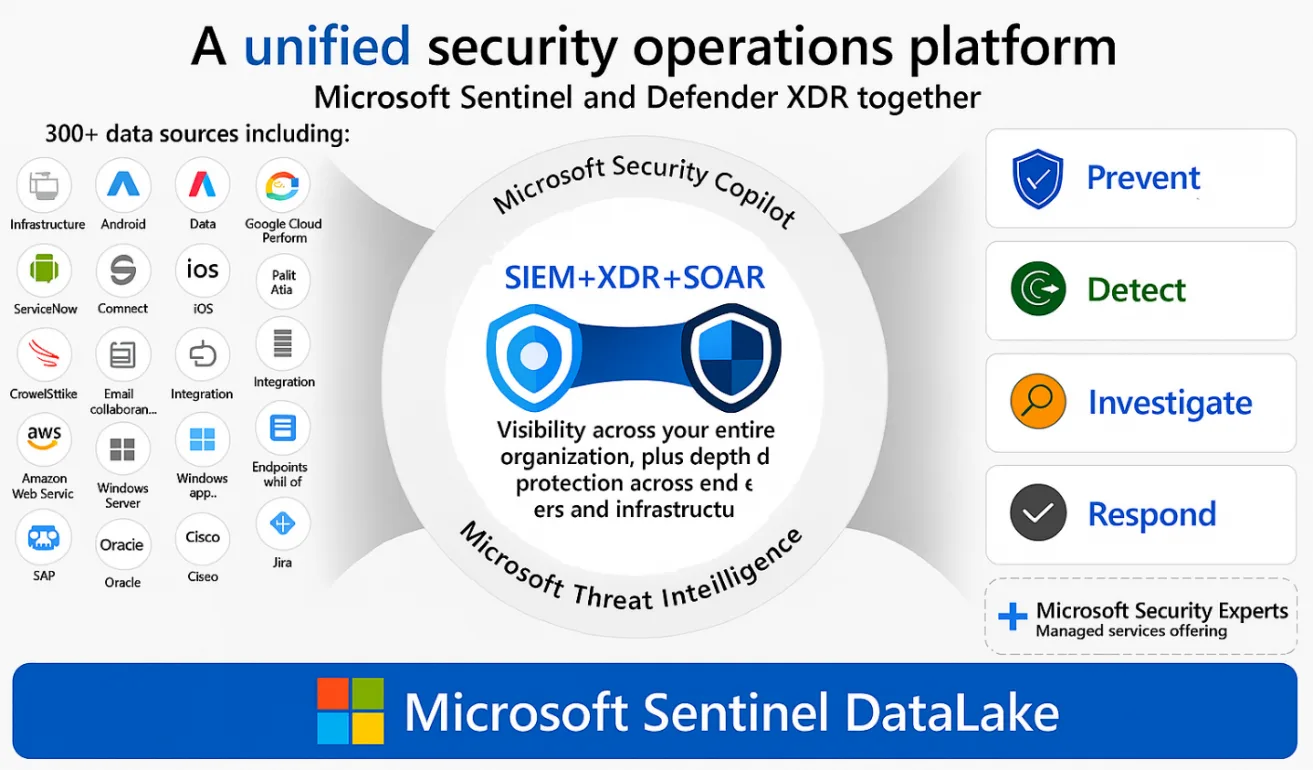
Simplified view of the core components. Source: microsoft.com
To meet this reality, platforms are emerging that consolidate previously separate functions. Among other things, the Unified Security Operations Platform brings together:
- Unified incident queue: A single queue that collects, prioritizes and correlates alerts from SIEM, XDR and third-party tools. Thousands of individual events become a few highly relevant incidents.
- Unified device timeline: A chronological view of all activity on devices, user accounts and applications. Analysts can run root cause analyses faster and trace attack paths.
- Role-based access control (RBAC): Consistent policies for identities and permissions. Analysts don’t have to jump between tools, and assigning rights in one place improves security.
- Multi-tenant management: Especially relevant for MSSPs and large enterprises. Several environments can be managed from one console, including hunting and automated playbooks.
Let’s take a closer look at the core components.
The heart of the platform: Defender XDR
Defender XDR is the heart of the Unified Security Operations Platform. It collects and correlates data from a wide range of sources: endpoints (Windows, Linux, macOS), identities (Microsoft Entra ID and on-premises directories), email systems, SaaS applications and cloud workloads (Azure, AWS, GCP).
This data is processed in a distributed graph database that links user actions, devices, processes and network connections. That makes it possible to detect attacks that span several layers.
Core capabilities:
- Advanced threat detection: Defender XDR uses machine learning and heuristics to detect unknown threats that no signature covers.
- Automated correlation: Individual alerts are grouped into incidents. Example: an unusual sign-in, combined with a suspicious PowerShell command and an outbound connection to an unknown IP, is recognized as one connected attack.
- Attack disruption: Defender XDR can step in actively, isolating devices, stopping processes or automatically disabling compromised accounts to limit the damage.
- Hunting and threat intelligence: With KQL (Kusto Query Language), analysts dig deep into the data and track down suspicious patterns. Security Copilot translates questions asked in natural language into KQL.
AI becomes a daily helper: Security Copilot
Security Copilot is the platform’s AI-powered analyst assistant. It is built on a large language model tailored to security data and attack patterns. Its main job is to take load off analysts through automation and context-aware answers.
The capabilities in detail:
- From natural language to action: Analysts ask questions in plain language, such as “Show me all compromised users in the last 24 hours”. Security Copilot turns them into KQL queries and returns the results.
- Automated summaries: Complex incidents are summarized in clear, understandable text, including affected systems, attack vectors and recommended countermeasures.
- Script explanation and analysis: Copilot analyzes unknown scripts (for example PowerShell or Python), comments on them and points out potentially malicious behavior.
- Threat intelligence integration: Through Microsoft Threat Intelligence, Copilot enriches indicators of compromise (IoCs) and explains current attack campaigns.
- Reporting and communication: Security Copilot writes reports for management and technical teams and prepares content in different formats.
New: Copilot agents as specialized assistants
Besides the core model, there are specialized agents, each optimized for a specific task. They work like additional virtual analysts in the SOC, around the clock.
- Phishing Triage Agent in Microsoft Defender: Scales the triage and classification of phishing reports submitted by users. This reduces manual effort and speeds up the phishing response.
- Vulnerability Remediation Agent in Microsoft Intune: Identifies the most important vulnerabilities, explains their impact and gives step-by-step guidance for fixing them with Intune.
- Conditional Access Optimization Agent in Microsoft Entra: Watches for new users and apps that existing policies don’t cover, identifies the updates needed to close the gaps and suggests fixes that identity teams can apply with a single click.
- Security Copilot agents in Microsoft Purview (preview): These agents for Data Loss Prevention (DLP) and Insider Risk Management (IRM) provide an agent-managed alert queue that identifies and prioritizes the alerts for the riskiest activities. The agent analyzes the content and likely intent of the activity based on the parameters and risk tolerance the organization has chosen.
Partners are building their own agents as well.
The value for the SOC: With agents, the Security Operations Center turns from a reactive into a proactive unit. Routine tasks are automated, analysts can focus on complex incidents, and response speed increases significantly. At the same time, an adaptive defense system emerges that learns from every interaction and every new attack pattern.
Microsoft Sentinel data lake: a new approach to security data
One of the most important innovations in the Unified Security Operations Platform is the Microsoft Sentinel data lake: a unified, highly scalable platform for storing and analyzing security data.
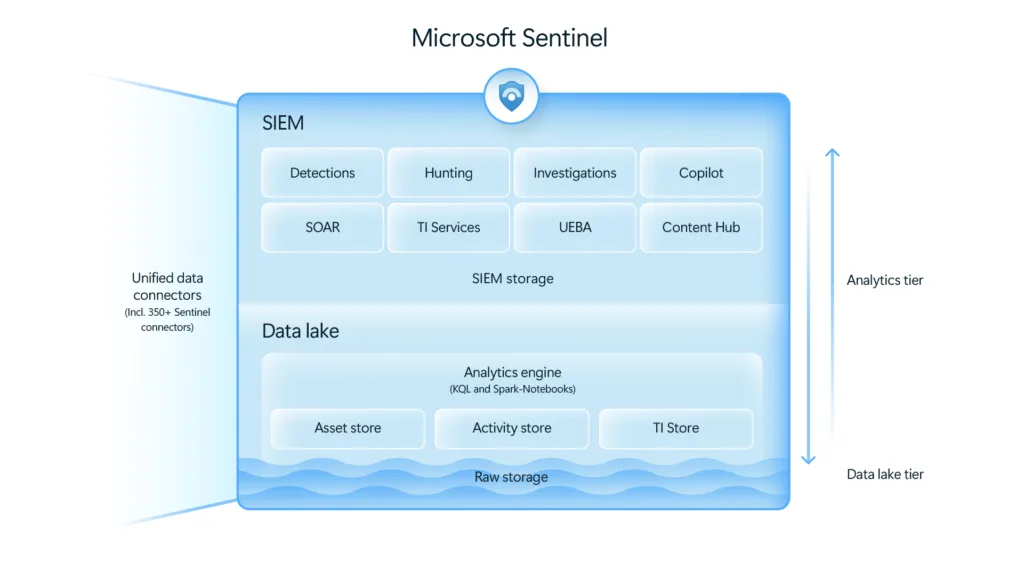
Source: microsoft.com
What exactly is the Sentinel data lake?
The Microsoft Sentinel data lake runs on the scalable infrastructure of Microsoft Azure and makes it easier to collect, analyze and act on data from many sources in one place. It natively ingests logs, telemetry, IoCs and context information, from Microsoft’s own tools as well as from third-party tools.
Analysts keep working with the familiar query language KQL. The result is one continuous platform that people and AI-powered agents such as Security Copilot can both use, for real-time analysis as well as for forensic investigations.
The Sentinel data lake offers the following tiers so data can be stored according to how often it is accessed and what it is used for:
| Tier | Purpose | Cost and retention |
|---|---|---|
| Analytics tier (hot) | Optimized for fast queries and immediate correlation; the “hot path” of Microsoft Sentinel. | More capable but more expensive than the lake. In practice you keep exactly the data here that active detection and investigation need. |
| Data lake tier (cold) | Extends the data for retrospective analysis and AI-powered Copilot and agent capabilities without making the hot path more expensive. | Long-term retention (up to 12 years) at a low cost per GB. Once the lake is enabled, data from the analytics tier is mirrored at no extra cost. |
| XDR tier (Defender XDR default) | Defender XDR keeps hunting data natively, optimized for working directly in Defender XDR. | Default retention of 30 days. XDR tables are not automatically added to Sentinel analytics or the lake. |
SOAR: automation as the backbone
Modern security architectures increasingly rely on Security Orchestration, Automation and Response (SOAR) to handle the growing number of alerts and incidents efficiently. Three approaches work together.
Sentinel playbooks
In Microsoft Sentinel, playbooks are built on Logic Apps. They standardize and automate recurring response processes, such as isolating a compromised endpoint, blocking a suspicious user account or passing indicators to firewalls and proxies. Playbooks are strongest when it comes to integrating external systems, meeting compliance requirements and orchestrating several security tools.
Copilot agents
The specialized Security Copilot agents extend classic SOAR logic with generative AI and context-aware decisions. They work out dynamically which playbooks or actions fit an incident best, trigger additional analysis (for example code analysis or phishing triage) and hand over results for further automation steps. Unlike static playbooks, Copilot agents adapt to new attack patterns.
Defender XDR automatic attack disruption
At the XDR level, Microsoft relies on preventive intervention in real time. Automatic attack disruption can, for example, stop lateral movement at an early stage, temporarily block compromised accounts or immediately isolate an infected device from the network, before a playbook is even triggered. The feature is optimized for speed and immediate damage control.
How it all fits together
The real strength lies in the combination: automatic attack disruption stops attacks in real time, Sentinel playbooks provide the structured orchestration framework, and Copilot agents add intelligent, context-aware extensions. The result is layered automation that reliably standardizes routine tasks, responds flexibly to new threats and takes immediate action in critical cases.
This makes the Security Operations Center not only faster but also more consistent and more resilient against modern attack scenarios.
Conclusion: the future of the SOC starts now
The combination of Microsoft Unified XDR, Security Copilot and the Sentinel data lake marks a turning point in the evolution of modern Security Operations Centers. What used to be fragmented, manual and reactive becomes an intelligent, integrated and proactive security platform.
Microsoft brings the complexity of today’s IT landscapes, from hybrid cloud environments and IoT to SaaS and remote work, together in one central architecture. The platform offers not only deep threat detection and automated response, but also seamless collaboration between people and AI.
Security Copilot acts not just as an assistant but as a digital analyst. With specialized agents for phishing triage, vulnerability management and incident orchestration, it lifts the SOC to a new level of efficiency. Routine tasks are automated, complex relationships are recognized faster and response times drop dramatically.
The Sentinel data lake is the backbone of this transformation: a scalable, cost-efficient and compliant data foundation that can be used for real-time analysis and forensic investigations for years.
The result is a Security Operations Center that doesn’t just react to threats but anticipates them, keeps learning and adapts dynamically to new attack patterns. Organizations that adopt this platform invest not only in technology, but in the resilience, speed and future-readiness of their cyber defense.